
500 Day Bitcoin Strategy: When to Buy Before 2028 Halving
The 500 Day Bitcoin Strategy Is Playing Out Exactly As Planned (Here’s Your 2027 Roadmap)
Look, I’ll be straight with you. Most crypto “strategies” sound great on a Medium post and fall apart the moment real money hits the table.
Table Of Content
- What Exactly Is the 500 Day Bitcoin Strategy?
- Where We Stand Today: The August 2025 Sell Signal
- The Math Behind the 500 Day Window
- What’s Next: The 2028 Halving and Your 2027 Entry
- Why This Strategy Appeals to Normal Humans (Not Just Traders)
- The Honest Drawbacks (Because Nothing’s Perfect)
- How to Actually Execute This (Practical Steps)
- 1. Mark Your Calendar
- 2. Decide Your Position Size Now
- 3. Choose Your Exit Strategy
- 4. Ignore the Noise in Between
- 5. Track Actual Halving Dates
- Real Talk: Is This Strategy Right for You?
- FAQ: Your 500 Day Bitcoin Questions Answered
But there’s one absurdly simple framework that keeps showing up in my conversations with long-term holders, and honestly? The track record is kind of hard to ignore.
It’s called the 500 Day Bitcoin strategy, and right now it’s moving along exactly as planned. If you’ve been following it, you already know. If you haven’t, buckle up — because the next buy window is coming in early 2027, and you’ve got time to decide if this is your kind of play.
What Exactly Is the 500 Day Bitcoin Strategy?
The concept is almost stupidly straightforward.
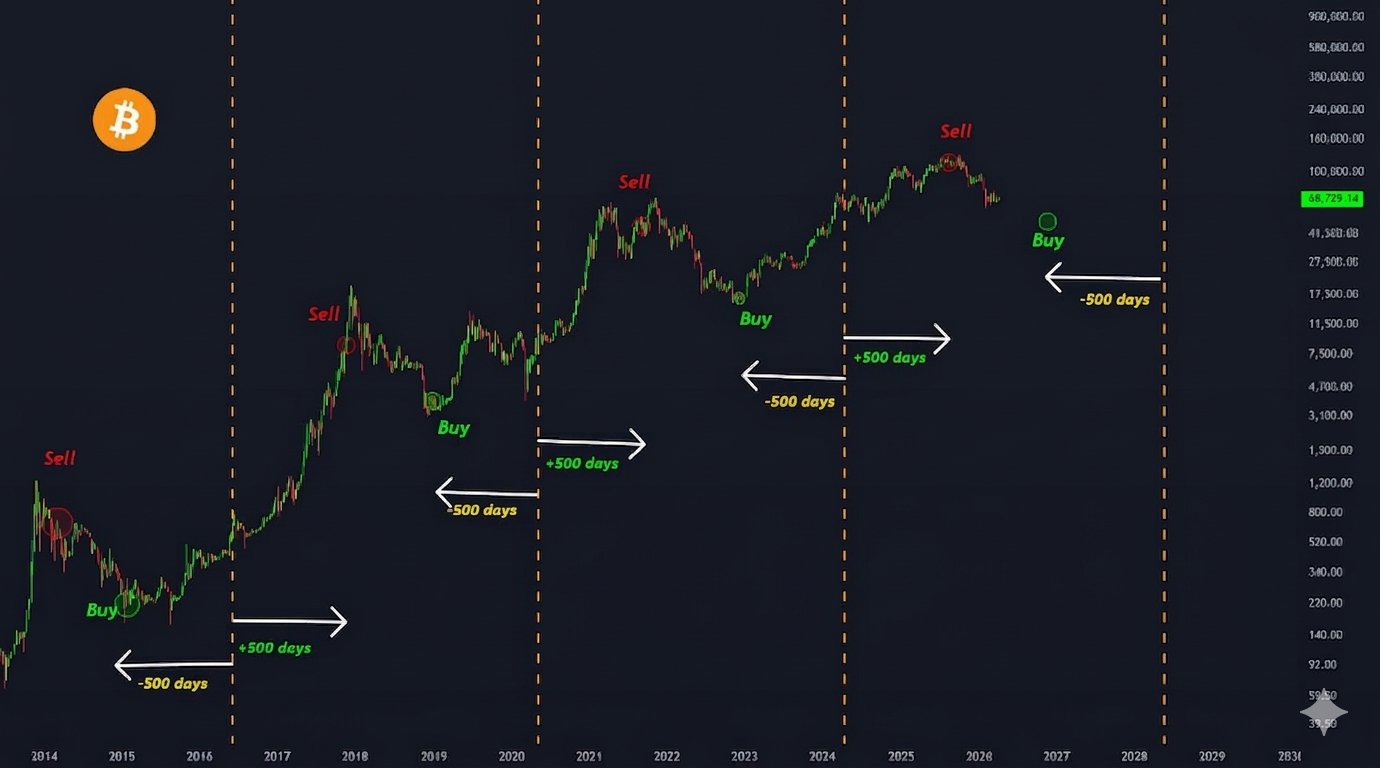
You buy Bitcoin 500 days before a halving event. You hold through the halving and the typical post-halving pump. Then you sell 500 days after that halving.
That’s it. No daily chart-watching, no leverage, no trying to catch every 3% swing.
The theory hinges on Bitcoin’s four-year halving cycle, which historically creates predictable waves of hype, euphoria, and eventual exhaustion. By timing your entry and exit around these cycles — specifically 500 days on either side — you’re aiming to ride the meaty part of the bull run and step aside before things get ugly.
Does it work every time? We’ll get to that. But first, let’s talk about where we are right now.
Where We Stand Today: The August 2025 Sell Signal
If you were following the 500 day approach, your most recent sell signal landed on August 24, 2025.
Bitcoin was sitting pretty at around $109,000 that day.
Now here’s the kicker: since that peak, BTC has already dropped roughly 45%. As I’m writing this, we’re watching the classic post-cycle cool-off that happens when the euphoria fades, the new retail buyers dry up, and everyone remembers that crypto winters are a thing.
I’ve been through enough of these to know the feeling. You sell near the top, watch it climb another 10% and feel like an idiot for a week. Then three months later it’s down 40% and you’re quietly relieved you actually stuck to the plan.
That’s the psychological game here. The strategy doesn’t promise you’ll nail the absolute top — it promises you’ll get close enough and then get the hell out before the real pain starts.
The Math Behind the 500 Day Window
Why 500 days? It’s not some mystical Fibonacci thing or moon phase calculation.
It’s pattern recognition based on historical cycle behavior. Bitcoin halvings occur roughly every four years (210,000 blocks, but who’s counting). The bull runs tend to build momentum before the halving as anticipation grows, then explode after as supply shock and media hype collide.
By going 500 days in either direction, you’re capturing:
- The pre-halving accumulation phase
- The halving event itself
- The 12–18 month post-halving mania
Then you exit before the 18–24 month hangover that follows every party.
It’s not perfect. The 2013 cycle was weird. The 2015–2017 run had different macro conditions. But as a general framework for people who don’t want to stare at TradingView for six hours a day? It holds up better than most.
What’s Next: The 2028 Halving and Your 2027 Entry
Alright, so you sold in August 2025 (or you’re kicking yourself because you didn’t). What now?
The next Bitcoin halving is estimated for May 27, 2028. That’s when the block reward drops from 3.125 BTC to 1.5625 BTC, and the supply shock conversation starts all over again.
If you’re playing the 500 day strategy, you don’t wait until May 2028 to buy. You go in 500 days earlier.
Count it back: January 13, 2027 is your next entry window.
That gives you roughly a year and a half from now to sit on the sidelines, stack cash, ignore the noise, and prepare for the next accumulation phase.
Why This Strategy Appeals to Normal Humans (Not Just Traders)
Here’s the thing most crypto influencers won’t tell you: trading is exhausting.
I tried the active trading thing back in 2017. I had Delta open on my phone 24/7, woke up to check Asian market opens, and spent more time watching 15-minute candles than I did with actual humans. I made some money, lost some money, and mostly just aged faster.
The 500 day Bitcoin method appeals to people like me who eventually realized we’re not built for that life. It’s for:
- People with day jobs who want exposure to Bitcoin’s cycles without becoming a full-time degen
- Folks who’ve been burned by “HODL forever” advice and watched 80% drawdowns eat their gains
- Anyone who wants a clear plan they can set, forget (mostly), and revisit at specific intervals
You’re not trying to outsmart the market. You’re just syncing your buy and sell windows to Bitcoin’s most reliable pattern: the halving cycle.
The Honest Drawbacks (Because Nothing’s Perfect)
Let me pump the brakes for a second.
This strategy sounds clean on paper, but real life is messier. Here are the parts that suck:
You might exit “too early.” If you sold in August 2025 at $109K and Bitcoin somehow grinds to $150K by December, you’ll feel like a moron. That’s the trade-off. You’re choosing good enough over perfect.
Macro conditions change. The 500 day approach assumes the four-year cycle continues to dominate Bitcoin’s price action. But what if institutional adoption smooths out volatility? What if regulation kills the retail FOMO that fuels these pumps? The past doesn’t guarantee the future.
Tax implications. Depending on where you live, selling at cycle tops means short-term or long-term capital gains. In some jurisdictions, that’s a hefty chunk of your profits. Make sure you’re accounting for that before you commit to this plan.
It requires discipline. The hardest part isn’t buying or selling — it’s waiting. Sitting in cash or stablecoins for 18 months while crypto Twitter screams about the next 100x shitcoin? That’s the real test.
How to Actually Execute This (Practical Steps)
If you’re seriously considering the 500 day approach, here’s how I’d do it:
1. Mark Your Calendar
Set a reminder for January 13, 2027. That’s your buy window. You don’t have to buy everything on that exact day — you can DCA over a few weeks or months around that date.
2. Decide Your Position Size Now
Don’t wait until 2027 to figure out how much you’re allocating. Do the math today. What percentage of your portfolio makes sense? What’s an amount you can lose without spiraling?
3. Choose Your Exit Strategy
The sell signal will come around November 2029 (500 days after the May 2028 halving). Will you sell 100% of your position? Or keep a small “forever stack” and only sell 70–80%?
Decide this now, not when Bitcoin is at $200K and you’re drunk on hopium.
4. Ignore the Noise in Between
Between now and January 2027, Bitcoin will pump and dump a dozen times. Ignore it. You’re not playing that game. Stay focused on the long cycle.
5. Track Actual Halving Dates
Halvings are based on block height, not calendar dates. The “May 27, 2028” estimate could shift by a few weeks depending on hash rate. Keep an eye on block explorers as we get closer.
Real Talk: Is This Strategy Right for You?
Honestly? It depends on your personality and goals.
If you’re someone who:
- Wants a simple, cyclical approach to Bitcoin
- Can handle sitting in cash for extended periods
- Prefers clear entry and exit rules over gut-feel decisions
- Doesn’t need to squeeze every last dollar out of every move
Then yeah, the 500 day Bitcoin strategy might be your jam.
But if you’re chasing 10x moonshots, love the thrill of daily trading, or genuinely believe in “HODL until retirement no matter what,” this framework will feel too conservative.
I’ve tested variations of this myself since 2020. It’s not sexy. It doesn’t make for great Twitter threads. But it’s kept me sane and mostly profitable through two full cycles now, which is more than I can say for a lot of the “diamond hands” crowd who rode their portfolios from $500K back down to $80K.
FAQ: Your 500 Day Bitcoin Questions Answered
When exactly is the next Bitcoin halving?
The next halving is estimated for May 27, 2028, but the exact date depends on block production speed. It occurs at block 1,050,000.
Do I have to buy all my Bitcoin exactly 500 days before the halving?
No. You can DCA (dollar-cost average) over several weeks or months around that window. The 500 day mark is a guideline, not a hard deadline.
What if I miss the January 2027 entry window?
You can still buy later, but you’ll have less time to accumulate before the halving pump begins. The strategy works best when you start early in the cycle.
Should I sell 100% of my Bitcoin at the 500 day exit signal?
That’s up to you. Some people sell everything and wait for the next cycle. Others keep a “forever stack” of 10–30% and only sell the rest. It depends on your conviction and risk tolerance.
Has this strategy actually worked in past cycles?
Historically, yes. Buying 500 days before previous halvings and selling 500 days after would have captured most of the bull run gains and avoided the worst of the bear market drawdowns. Of course, past performance doesn’t guarantee future results.
What do I do with my money between sell and buy windows?
Most people park it in stablecoins, high-yield savings, or short-term treasuries. The goal is to preserve capital and earn a bit of yield while you wait for the next entry.
Can this strategy work with altcoins too?
Technically yes, but altcoins don’t follow the halving cycle as reliably as Bitcoin. They tend to pump later and crash harder. If you’re going to use this framework, Bitcoin is the safest bet.
So there you have it. The 500 day Bitcoin strategy is still chugging along, exactly as the roadmap predicted. You’ve got a year and a half to prepare for the next entry, plenty of time to stack cash and decide if this is the approach that fits your life.
No guarantees. No moonboy promises. Just a simple, cyclical plan that’s worked more often than not.
See you in January 2027.